
Which Advanced Technology Does Richmond Endo Use for Root Canal Retreatment?
Modern endodontics has moved far beyond manual files and basic magnification. According to the American Association of Endodontists, advanced imaging and rotary instrumentation have significantly improved retreatment success rates by allowing clinicians to visualize complex canal anatomy with unprecedented clarity. At Richmond Endo, we leverage this exact technological evolution to save teeth that other providers might deem hopeless. This article details the specific high-fidelity tools and protocols we employ during root canal retreatment procedures.
Diagnostic Imaging: The CBCT Advantage
Traditional two-dimensional X-rays often fail to reveal the full complexity of a failed root canal. Missing canals, vertical root fractures, and complex apical anatomy are frequently obscured in standard periapical radiographs. To address this, Richmond Endo utilizes Cone Beam Computed Tomography (CBCT) as a standard diagnostic tool for complex retreatment cases.
CBCT is a specialized type of X-ray that produces a three-dimensional image of the teeth and surrounding bone structures. This technology allows us to see the tooth from every angle, identifying issues that are invisible on flat films. Data shows that CBCT imaging increases the detection of missed canals by up to 40% compared to conventional radiography. By mapping the exact 3D anatomy of the root system, we can plan a retreatment strategy that is both precise and minimally invasive.
We only utilize CBCT when clinically indicated to adhere to the ALARA (As Low As Reasonably Achievable) principle for radiation exposure. For straightforward cases, high-resolution digital radiography remains sufficient. However, for retreatments involving complex anatomy or persistent infection, the 3D view is indispensable. You can learn more about our diagnostic protocols on our Diagnostic Imaging page.
Microscopic Visualization Standards
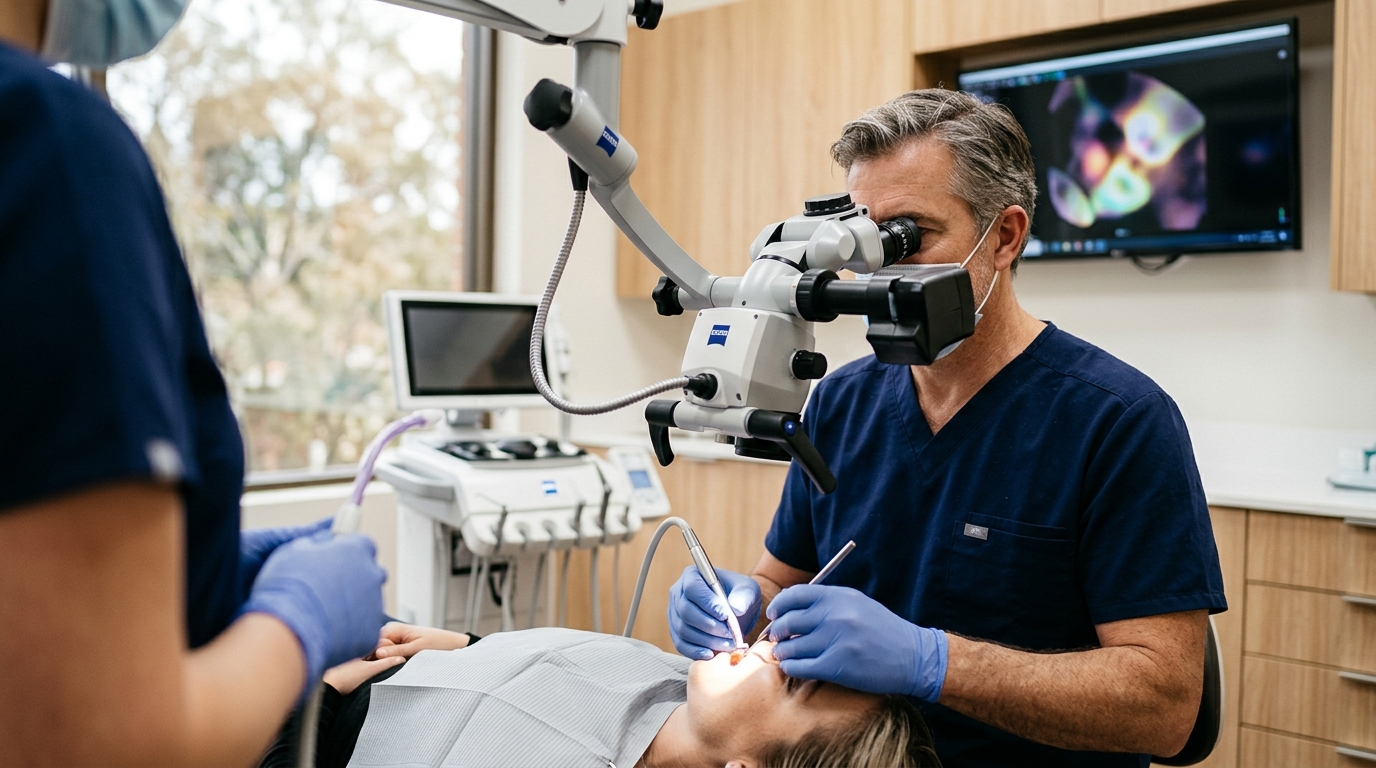
The operating microscope is the cornerstone of modern endodontic retreatment. At Richmond Endo, we use high-magnification surgical microscopes that provide up to 25x magnification and intense coaxial illumination. This level of visualization is not merely a luxury; it is a clinical necessity for successful retreatment.
Microscopic Endodontics is the practice of using a surgical microscope to perform endodontic procedures with enhanced precision. The microscope allows us to see the fine details of the root canal system, including calcified canals, fractured instruments, and subtle cracks in the tooth structure. Without this magnification, a clinician is essentially working in the dark, relying on guesswork rather than visual confirmation.
Our microscopes are equipped with integrated cameras, allowing us to document the procedure and share findings with referring dentists and patients. This transparency builds trust and ensures that every step of the retreatment is recorded for future reference. For more details on our clinical standards, visit our Clinical Standards overview.
Rotary Instrumentation and Nickel-Titanium Files
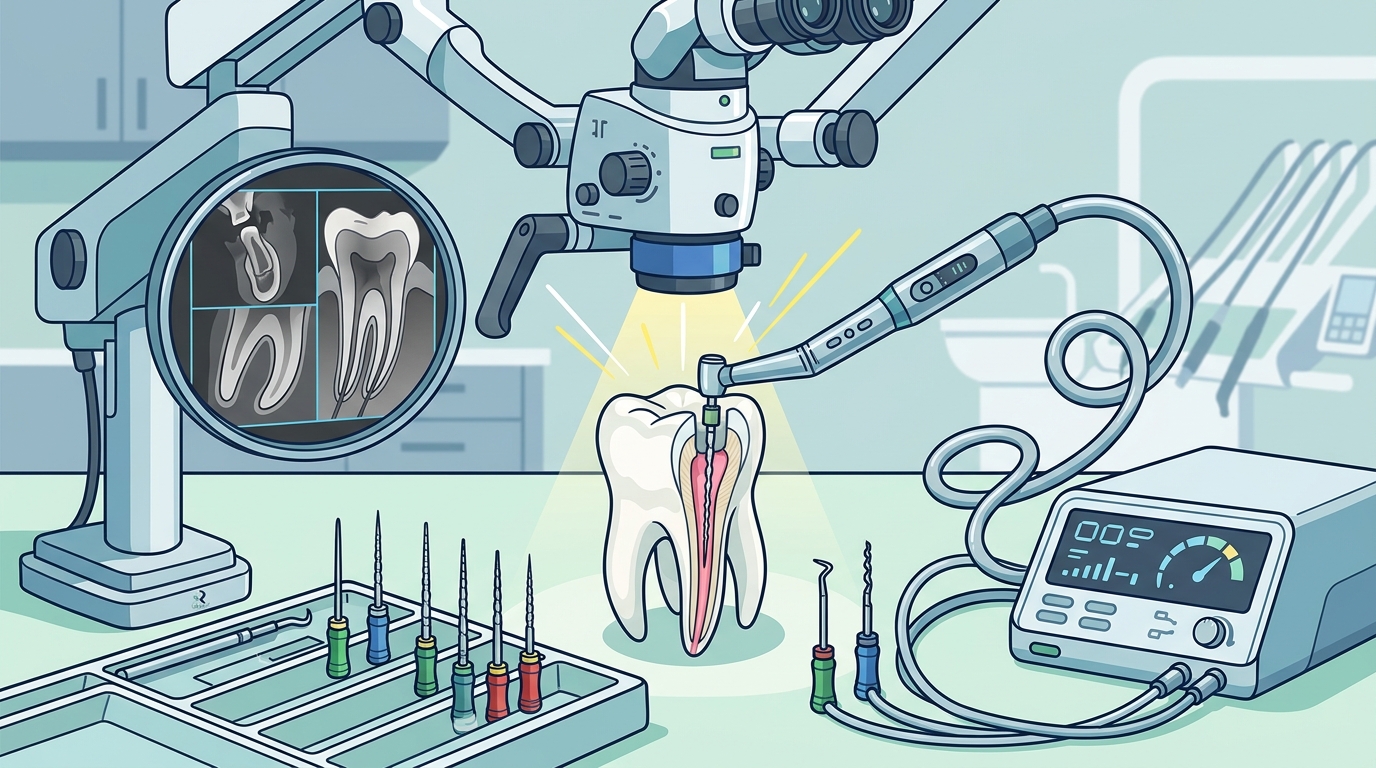
Retreatment often involves removing old filling materials, such as gutta-percha and sealer, from the root canal system. This process requires specialized instruments that are both strong and flexible. Richmond Endo utilizes advanced nickel-titanium (NiTi) rotary files that are engineered to navigate curved canals without causing iatrogenic errors.
Nickel-titanium files are made from an alloy of nickel and titanium that provides superelasticity and shape memory. Unlike stainless steel files, which are rigid and prone to breaking in curved canals, NiTi files can adapt to the natural curvature of the root. This adaptability reduces the risk of canal transportation, ledging, or perforation during the removal of previous restorations.
We employ a systematic approach to instrumentation, using sequential file sizes to gradually enlarge and shape the canal. This method ensures that the entire canal surface is cleaned and disinfected. Our commitment to using the latest instrumentation technology is detailed in our Endodontic Treatment services section.
Ultrasonic Irrigation Activation
Chemical disinfection is just as critical as mechanical cleaning. The root canal system contains complex anatomy, including dentinal tubules and lateral canals, where bacteria can hide. Standard syringe irrigation often fails to reach these areas effectively. To combat this, Richmond Endo uses ultrasonic activation of irrigants.
Ultrasonic Irrigation Activation involves using high-frequency sound waves to agitate the disinfecting solution within the root canal. This agitation creates acoustic streaming and cavitation, which disrupts the biofilm and removes debris from areas that mechanical files cannot reach. Studies indicate that ultrasonic activation can reduce bacterial load more effectively than passive irrigation alone.
We typically use sodium hypochlorite (NaOCl) as the primary irrigant, combined with ethylenediaminetetraacetic acid (EDTA) to remove the smear layer. The ultrasonic tip allows us to deliver these solutions deep into the apical third of the root canal, ensuring a sterile environment for healing. Learn more about our disinfection protocols on our Infection Control page.
Thermoplasticized Obturation Systems
Once the canal is cleaned and shaped, it must be sealed to prevent reinfection. Traditional cold lateral condensation of gutta-percha can leave voids where bacteria may survive. Richmond Endo utilizes thermoplasticized obturation systems to achieve a hermetic seal of the root canal system.
Thermoplasticized Obturation is a technique where gutta-percha is heated to a liquid-like state and injected into the canal under pressure. This allows the material to flow into all irregularities, lateral canals, and dentinal tubules, creating a dense, three-dimensional fill. This method significantly reduces the risk of microleakage and subsequent treatment failure.
The heated gutta-percha also softens the previous filling material, making its removal easier and safer. This synergy between obturation and retreatment instrumentation enhances the overall efficiency of the procedure. For information on our restorative options, please review our Restorative Options.
Technology Comparison: Traditional vs. Advanced Retreatment
Understanding the difference between traditional and advanced retreatment helps patients appreciate the value of modern endodontics. The table below summarizes the key technological distinctions.
| Feature | Traditional Retreatment | Advanced Retreatment at Richmond Endo |
|---|---|---|
| Visualization | Unaided eye or loupes | Surgical Operating Microscope (up to 25x) |
| Imaging | 2D Periapical X-rays | 3D Cone Beam CT (CBCT) when indicated |
| Instrumentation | Stainless Steel Hand Files | Superelastic Nickel-Titanium Rotary Files |
| Disinfection | Passive Syringe Irrigation | Ultrasonic Activation of Irrigants |
| Obturation | Cold Lateral Condensation | Thermoplasticized Gutta-Percha |
Key Takeaways
- Richmond Endo uses Cone Beam Computed Tomography (CBCT) to visualize complex root anatomy in three dimensions.
- Surgical operating microscopes provide up to 25x magnification, essential for locating missed canals and removing fractured instruments.
- Nickel-titanium rotary files allow for safe and efficient cleaning of curved canals during retreatment.
- Ultrasonic irrigation activation enhances disinfection by agitating solutions into complex canal anatomy.
- Thermoplasticized obturation creates a superior seal compared to traditional cold lateral condensation.
- Advanced technology significantly improves the predictability and longevity of root canal retreatment.
Frequently Asked Questions
What is root canal retreatment?
Root canal retreatment is a procedure performed to save a tooth that has previously undergone root canal therapy but has failed to heal or has become reinfected. It involves removing the existing filling material, cleaning the canal again, and resealing it.
Why do I need a CBCT scan for retreatment?
A CBCT scan provides a 3D view of the tooth and surrounding bone, allowing the endodontist to detect issues like missed canals, fractures, or complex anatomy that are not visible on standard 2D X-rays.
Is root canal retreatment painful?
With modern anesthesia and advanced techniques, root canal retreatment is typically no more uncomfortable than the initial root canal procedure. Most patients report minimal post-operative sensitivity.
How long does a retreatment take?
The duration varies based on the complexity of the case. Simple retreatments may take one visit, while complex cases involving CBCT analysis and intricate anatomy may require two or more visits.
What is the success rate of retreatment?
Success rates for retreatment are high, often exceeding 80%, particularly when advanced technologies like microscopes and CBCT are utilized to ensure thorough cleaning and sealing.
Can a retreatment tooth be crowned?
Yes, after successful retreatment, the tooth usually requires a crown or other restoration to protect it from fracture and restore its function. We coordinate closely with your general dentist for this step.
What is the role of the operating microscope?
The operating microscope allows the endodontist to see fine details in the root canal system, ensuring that all canals are located, cleaned, and sealed effectively.
How do I know if I need retreatment?
Symptoms such as persistent pain, swelling, or a recurring pimple on the gums may indicate retreatment is needed. Your endodontist will diagnose this through clinical examination and imaging.
Schedule Your Consultation
If you are experiencing pain or have been referred for root canal retreatment, do not delay. Early intervention with advanced technology offers the best chance of saving your natural tooth. Richmond Endo is dedicated to providing the highest standard of care using the latest in endodontic science.
Contact our Richmond office today to schedule a consultation. Our team is ready to evaluate your case and discuss how our advanced technology can help you achieve a healthy, pain-free smile. Visit our Contact Us page to book your appointment online or call us directly.