

According to the American Association of Endodontists, approximately 1 in 4 root canals may require retreatment at some point in a patient's lifetime. This statistic highlights that even the most successful initial procedures are not immune to long-term biological or mechanical challenges. If you are experiencing persistent discomfort or new sensitivity in a previously treated tooth, understanding the specific indicators of failure is critical for preserving your natural dentition. Ignoring these signs can lead to more complex infections, bone loss, and the eventual loss of the tooth entirely.
Why Root Canal Retreatment Is Necessary
Root canal retreatment is a specialized procedure designed to save a tooth that has failed to heal or has become reinfected after an initial root canal therapy. Root canal retreatment is the process of re-accessing a previously treated tooth to remove old filling materials, clean the canals again, and seal the space to prevent further bacterial invasion. This procedure is not a sign of poor initial care but rather a response to complex anatomical factors or new biological challenges.
Several factors can compromise the success of an initial root canal. These include curved or narrow canals that were not detected during the first procedure, complex branching of the root canal system, or delayed placement of a crown that allowed bacteria to re-enter the tooth. Additionally, new decay can develop if proper oral hygiene is not maintained, allowing bacteria to contaminate the filling material and infect the root canal system again.
At Richmond Endodontics, we understand that retreatment requires a higher level of precision and expertise. Our team is dedicated to utilizing the latest technology to navigate these complex cases and restore your oral health. For more information on our general approach to endodontics, visit our Endodontics page.
Clinical Signs and Symptoms of Failure
Identifying the need for retreatment often begins with recognizing specific symptoms that indicate the tooth is no longer healthy. While some patients may be asymptomatic, others experience distinct signs that require immediate professional evaluation.
Persistent Pain and Sensitivity
The most common indicator of a failing root canal is pain. This pain may be constant or intermittent and can range from mild discomfort to severe, throbbing agony. Persistent pain is often a sign that the infection has spread to the surrounding bone and tissues. You may also experience sensitivity to hot or cold temperatures, although this is less common in teeth that have already undergone root canal therapy since the nerve tissue has been removed. If sensitivity persists, it may indicate that a canal was missed during the initial treatment or that the seal has broken.
Swelling and Tenderness
Swelling in the gums near the treated tooth is a clear sign of infection. This swelling may appear as a pimple-like bump on the gum line, known as a sinus tract, which can drain pus and cause a bad taste in the mouth. Tenderness to chewing or tapping on the tooth indicates that the inflammation has extended beyond the root tip into the periodontal ligament. This tenderness is often the first sign that the bone surrounding the root is being compromised by bacterial activity.
Discoloration of the Tooth
If the tooth begins to darken or change color compared to the surrounding teeth, it may indicate that the internal structure is breaking down or that there is ongoing necrosis. This discoloration is often a result of blood breakdown products leaking into the dentin tubules due to a compromised seal.
If you are experiencing any of these symptoms, it is crucial to contact your endodontist immediately. You can learn more about our office policies and patient care at About Our Office.
The Diagnostic Process for Retreatment
Accurate diagnosis is the cornerstone of successful retreatment. At Richmond Endodontics, we employ a rigorous diagnostic protocol to determine the exact cause of failure and the best course of action. This process involves a combination of clinical examination and advanced imaging technology.
Clinical Examination
During your initial consultation, Dr. Benjamin Adams will perform a thorough clinical examination. This includes testing the tooth for percussion sensitivity, palpation of the surrounding tissues, and periodontal probing to check for deep pockets that may indicate a vertical root fracture. We also evaluate the integrity of the existing restoration to ensure that any new crown or filling will provide a hermetic seal upon completion of the retreatment.
Advanced Imaging and Microscopy
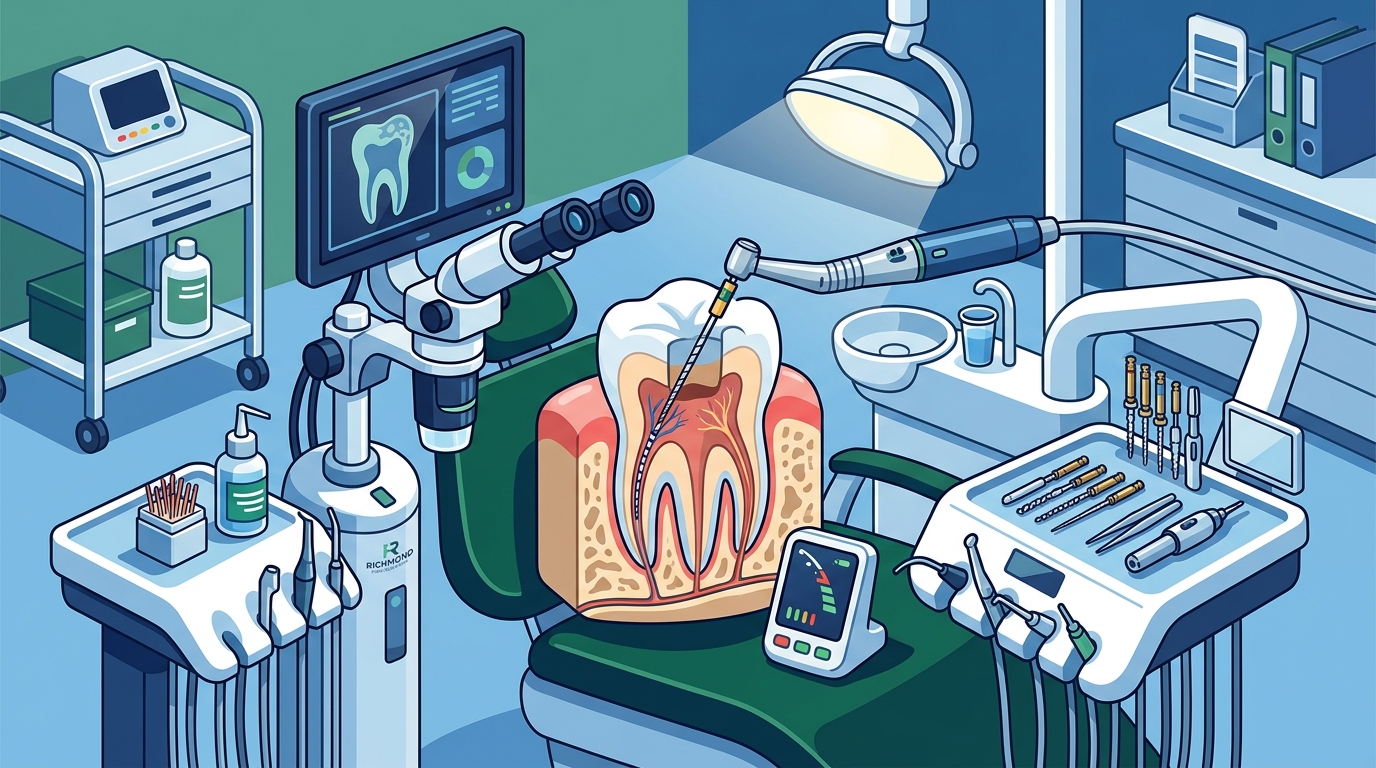
Standard 2D X-rays are often insufficient for diagnosing complex retreatment cases. We utilize PreXion CBCT imaging to obtain a three-dimensional view of the tooth and surrounding bone. This technology allows us to detect hidden canals, fractures, and bone loss that are not visible on traditional radiographs. PreXion CBCT imaging provides highly detailed 3D imaging with lower radiation exposure, allowing us to visualize your teeth and surrounding structures with unparalleled clarity.
Furthermore, we use the Zeiss ProErgo surgical microscope to examine the tooth at high magnification. This microscope enables us to locate calcified canals, remove broken instruments, and ensure that all previous filling materials are completely removed. The precision offered by this technology is critical for the success of retreatment procedures.
To schedule a diagnostic evaluation, please visit our Contact Us page.
Advanced Technology in Retreatment
Retreatment is technically demanding and requires advanced tools to navigate the complexities of previously treated teeth. Richmond Endodontics is one of the few practices in the country offering GentleWave® and EdgePro® laser disinfection, which significantly enhances the outcomes of retreatment.
GentleWave® Multishape Technology
The GentleWave® system uses multiscale, multiphysics, and synergistic energy to clean the root canal system. Unlike traditional methods that rely heavily on manual filing, GentleWave® uses fluid dynamics and acoustic energy to reach into complex anatomy, including isthmuses and lateral canals, that are often missed by conventional instruments. This results in a more thorough disinfection and a higher likelihood of long-term success.
EdgePro® Laser Disinfection
EdgePro® laser technology offers a more efficient and precise way to clean and disinfect the root canal system. The laser energy can penetrate deep into the dentinal tubules and accessory canals, killing bacteria that may be resistant to chemical irrigants. This enhances healing and reduces the risk of reinfection, which is particularly important in retreatment cases where bacterial biofilms are often more established.
For a deeper dive into our technological capabilities, explore our Advanced Technology page.
Retreatment vs. Extraction
When a tooth fails, the primary decision is whether to attempt retreatment or to extract the tooth. While extraction is a definitive solution, it comes with significant long-term consequences for your oral health and function.
| Factor | Root Canal Retreatment | Tooth Extraction |
|---|---|---|
| Preservation of Natural Tooth | Yes. Maintains natural bite force and sensation. | No. Requires replacement with an implant or bridge. |
| Cost | Generally lower than extraction and implant placement. | Higher due to the need for prosthetic replacement. |
| Treatment Time | Typically 1-2 visits. | Months, including healing and implant integration. |
| Long-Term Success | High success rate with advanced technology. | Dependent on implant success and bone health. |
Retreatment is often the preferred option because it preserves your natural tooth structure. Losing a tooth can lead to shifting of adjacent teeth, bone loss in the extraction site, and difficulties with chewing. If you are considering your options, we encourage you to read more about our Endodontic FAQ to understand the benefits of saving your natural tooth.
Key Takeaways
- High Prevalence of Failure: Approximately 1 in 4 root canals may require retreatment, indicating that failure is a common biological possibility rather than a rare anomaly.
- Primary Symptoms: Persistent pain, swelling, tenderness to chewing, and tooth discoloration are the most reliable indicators of retreatment need.
- Diagnostic Precision: The use of PreXion CBCT imaging and the Zeiss ProErgo surgical microscope is essential for detecting hidden pathology in complex cases.
- Technological Advantage: Richmond Endodontics utilizes GentleWave® and EdgePro® laser disinfection to achieve superior cleaning in retreatment scenarios.
- Expert Leadership: Dr. Benjamin Adams brings over 20 years of experience in surgical and non-surgical endodontics to every retreatment case.
- Service Area: We serve patients across Eastern Indiana and Western Ohio, including Richmond, Dayton, and surrounding communities.
- Immediate Action: Early diagnosis and treatment of failing root canals can prevent bone loss and save the tooth from extraction.
Frequently Asked Questions
How long does root canal retreatment take?
Root canal retreatment typically requires one to two visits, depending on the complexity of the case. The procedure involves removing the existing restoration, locating all canals, cleaning the space, and sealing the tooth. Dr. Adams will provide a more accurate timeline after a thorough examination.
Is root canal retreatment painful?
With modern anesthesia and sedation techniques, the procedure itself is generally no more uncomfortable than the initial root canal. Post-operative discomfort is usually mild and can be managed with over-the-counter pain medication. Our goal is to ensure your comfort throughout the entire process.
What is the success rate of retreatment?
The success rate of root canal retreatment is high, particularly when advanced technologies like the Zeiss ProErgo microscope and GentleWave® system are used. Success depends on factors such as the extent of the infection, the quality of the final restoration, and the patient's oral hygiene.
Can I get a crown after retreatment?
Yes, a crown is almost always recommended after retreatment to protect the tooth from fracture and to provide a new seal against bacteria. We coordinate closely with your general dentist to ensure the timely placement of the final restoration.
What is GentleWave® technology?
GentleWave® is a non-invasive, multiscale, multiphysics, and synergistic energy technology that cleans the root canal system. It uses fluid dynamics and acoustic energy to disinfect complex anatomy, offering a more thorough clean than traditional methods.
How do I know if my root canal failed?
Signs of failure include persistent pain, swelling, tenderness to biting, and the appearance of a pimple on the gums. However, some failures are asymptomatic and are only detected through routine X-rays. Regular check-ups are essential for early detection.
Do you offer payment plans?
Yes, we offer flexible payment plans to make advanced endodontic care accessible. Please visit our Contact Us page to discuss financing options with our team.
Schedule Your Consultation Today
If you suspect that your previously treated tooth is failing, do not wait for the pain to become unbearable. Early intervention is key to saving your natural tooth and preventing more serious complications. Dr. Benjamin Adams and his team at Richmond Endodontics are here to provide you with the highest standard of care using the most advanced technology available.
We serve patients across Eastern Indiana and Western Ohio, including Richmond, Centerville, Cambridge City, Connersville, Winchester, Union City, Portland, Dayton, Greenville, Eaton, Troy, Springfield, Urbana, and Celina. Contact us today to schedule your diagnostic evaluation and take the first step toward restoring your oral health.
Click here to schedule your appointment with Richmond Endodontics.