

Root Canal Retreatment vs. Surgery: Cost and Care Guide for Richmond, Indiana
Root canal retreatment and root canal surgery are distinct endodontic procedures with different costs, recovery times, and success rates. In Richmond, Indiana, the price varies based on case complexity and the specific technology used. This guide explains how to choose the right treatment, what to expect from the process, and how to manage costs at Richmond Endodontics. according to Non surgical root
How to Choose the Right Treatment
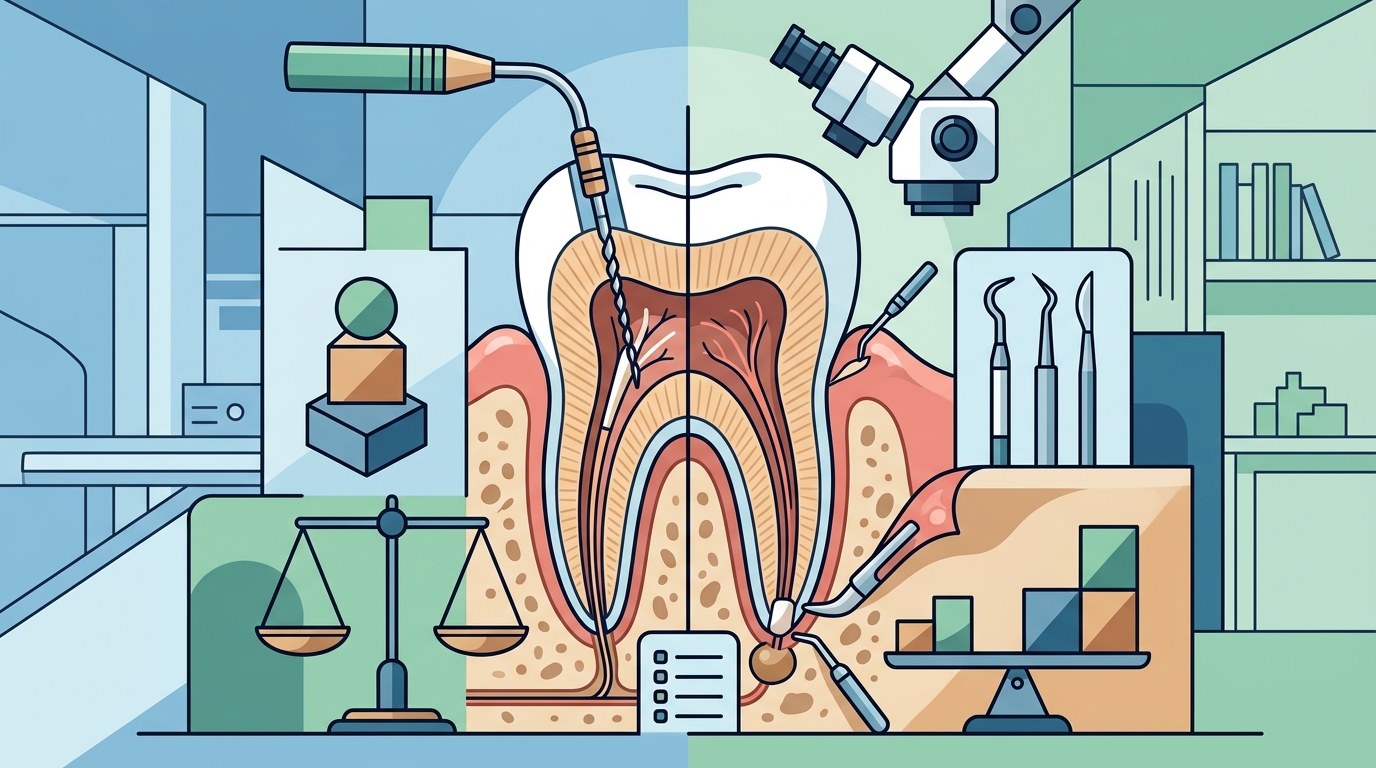
Choosing between retreatment and surgery depends on the specific reason for the initial failure. Root canal retreatment is a non-surgical procedure where the dentist removes the previous filling material to clean and refill the canals. Root canal surgery, also known as an apicoectomy, involves operating on the gum and bone to remove the root tip. A good provider will use advanced imaging to determine which option is viable. At Richmond Endodontics, we utilize 3D imaging to visualize hidden canals or fractures that standard X-rays miss. This diagnostic precision ensures you are not undergoing a more invasive procedure if a simpler retreatment will solve the problem.
Questions to Ask Before Committing
Before scheduling a procedure, you must understand the scope of the work. Ask your provider if they use a surgical microscope, as this significantly improves the ability to detect microscopic cracks. Inquire about the specific disinfection technologies used, such as laser or acoustic streaming, which reduce the risk of reinfection. You should also ask about the expected success rate for your specific tooth. Dr. Benjamin Adams, who has over 20 years of experience, emphasizes that patients should understand why the previous treatment failed. If the cause is a vertical root fracture, neither retreatment nor surgery may be successful, and extraction might be the only option.
Verifying Credentials and Claims
An endodontist is a dentist who has completed a minimum of two years of postgraduate training beyond dental school. You can verify this training through the American Association of Endodontists directory. Check if the provider is a member of the American Dental Association, which recognizes endodontics as a specialty. At Richmond Endodontics, Dr. Adams completed his residency at the Indiana University School of Dentistry. Verifying these credentials ensures you are seeing a specialist rather than a generalist performing complex work. This distinction matters because specialists are trained to handle the anatomical variations that cause treatment failure.
The Treatment Process and Timeline
Retreatment typically requires one to two visits. The provider removes the old filling, cleans the canals, and places a temporary filling. You then return to your general dentist for a permanent crown. Surgery is a single-visit procedure where the gum is opened to access the root tip. The process involves removing the infected tissue and sealing the root end. Recovery from surgery involves mild swelling for a few days. Both procedures are performed under local anesthesia. The first visit at our office includes a consultation to explain the diagnosis and treatment options clearly.
Cost Drivers and Financial Options
Costs vary based on the number of canals, the complexity of the anatomy, and the technology used. Retreatment is generally less expensive than surgery because it does not involve bone or gum incisions. However, if the tooth requires a new crown, that cost is separate. At Richmond Endodontics, we offer flexible payment plans to make care accessible. We accept CareCredit financing, which offers up to 12 months of interest-free payments. We also provide an in-office payment plan that allows you to spread costs over up to six months. We are not in-network with insurance providers, but we verify your benefits and provide an estimated out-of-pocket cost before treatment begins.
| Procedure | Typical Complexity | Recovery Time | Primary Cost Driver |
|---|---|---|---|
| Root Canal Retreatment | Low to Moderate | 1-2 Days | Number of Canals |
| Root Canal Surgery | Moderate to High | 3-7 Days | Surgical Access and Bone Work |
| Extraction and Implant | High | Several Months | Implant Hardware and Bone Grafting |
Common Mistakes to Avoid
One common mistake is delaying treatment when pain returns. Ignoring symptoms can lead to a larger abscess, making the procedure more difficult and expensive. Another error is assuming that a new crown will fix the problem. If the nerve is dead or infected, a crown will not stop the pain. Patients should also avoid choosing a provider based solely on price. Cheap treatments often lack the advanced technology needed to clean complex canal systems. Using a microscope and 3D imaging reduces the chance of missing a canal, which is a leading cause of failure.
Retreatment vs. Surgery vs. Extraction
Extraction is the alternative to saving the tooth. While extraction is often cheaper upfront, the long-term cost of an implant or bridge is significantly higher. Saving the natural tooth preserves bone and sensation. Retreatment is preferred when the previous filling was incomplete or if a new canal was discovered. Surgery is preferred when the root tip is infected or if there is a blockage that cannot be cleared non-surgically. The choice depends on the anatomy. If a vertical fracture is present, extraction is the only viable option. A specialist can diagnose this with high accuracy using magnification.
Treatment for Complex Cases
Some cases involve teeth with curved roots or calcified canals. These require specialized instruments and expertise. Dr. Adams frequently lectures nationwide on advancements in endodontics, including the GentleWave System. This technology uses acoustic streaming to clean canals more effectively than traditional methods. For patients with a history of failed treatments, a specialist is essential. General dentists may not have the training to navigate these complex anatomies. The use of a Zeiss ProErgo surgical microscope allows for superior magnification and lighting, ensuring that the finest details are visible.
Patient Rights and Protections
Patients have the right to informed consent. This means you must understand the risks, benefits, and alternatives before agreeing to treatment. You also have the right to a clear estimate of costs. In Indiana, dental practices must adhere to strict infection control standards set by OSHA and the CDC. At Richmond Endodontics, we utilize autoclave sterilization and barrier techniques to eliminate infection risk. You should feel comfortable asking for a copy of your X-rays and treatment records. These documents are your property and can be shared with other providers if you choose to seek a second opinion.
Local Care in Richmond, Indiana
Richmond Endodontics is located at 1427 Chester Blvd. in Richmond, Indiana. The practice serves patients from Eastern Indiana and Western Ohio. Our office hours are Monday through Thursday from 7:30 AM to 3:00 PM, and Friday from 7:30 AM to 12:00 PM. We intentionally see fewer patients per day to allow for ample treatment time. This approach ensures thorough patient education and open communication. Unlike high-volume practices, we prioritize a stress-free and supportive experience. The team includes experienced dental assistants and a patient concierge dedicated to easing dental anxiety.
The Impact of Timing on Outcomes
Timing is critical in endodontics. If you experience sharp pain when biting, you should seek care immediately. Delaying treatment can allow the infection to spread to the jawbone. This can lead to a more complex surgical procedure. If you have a swelling or abscess, you need to be seen within 24 to 48 hours. Early intervention often results in a simpler and less painful treatment. The retreatment process is most successful when the infection is contained. Waiting months or years can make the tooth unsalvageable. Proactive care is always less expensive than emergency care.
Long-Term Results and Maintenance
With appropriate care, teeth that have had endodontic treatment will last as long as other natural teeth. The success rate for retreatment is high when performed by a specialist. You should return to your general dentist for a follow-up restoration within a few weeks of completion. A crown is necessary to protect the tooth from breaking. We recommend that patients return to our office either 6 months or 1 year after the procedure for a check-up. This ensures the tooth is healing properly. Regular dental cleanings and check-ups are essential for maintaining the health of the surrounding gums and bone.
Key Takeaways
- Retreatment is generally less invasive and less expensive than root canal surgery.
- Advanced technology like 3D imaging and microscopes improves diagnostic accuracy.
- Specialists with postgraduate training are better equipped to handle complex cases.
- Financial options like CareCredit and in-office plans can make treatment more affordable.
- Delaying treatment can lead to more complex and costly procedures.
- A crown is required after endodontic treatment to protect the tooth.
- Patients have the right to informed consent and clear cost estimates.
- Richmond Endodontics offers specialized care in Richmond, Indiana, with flexible scheduling.
Frequently Asked Questions
Is root canal surgery more expensive than retreatment?
Yes, surgery is typically more expensive because it involves operating on the gum and bone. Retreatment is a non-surgical procedure that is generally less costly. The exact price depends on the complexity of the case.
How long does root canal surgery take?
Surgery is usually a single-visit procedure that takes about one to two hours. Recovery involves mild swelling for a few days. Retreatment may require one to two visits.
Can I get a root canal retreatment at Richmond Endodontics?
Yes, we offer root canal retreatment for patients in Richmond, Indiana, and surrounding areas. We use advanced technology to ensure the best possible outcome.
Do you accept dental insurance?
We accept all dental insurance plans but are not in-network with any providers. We verify your benefits and provide an estimated out-of-pocket cost before treatment.
What is the success rate of root canal retreatment?
The success rate is high when performed by an experienced specialist. Factors like the cause of the initial failure and the anatomy of the tooth affect the outcome.
How do I pay for my treatment?
We offer CareCredit financing and an in-office payment plan. You can spread payments over up to six months with auto-pay.