

Root Canal Retreatment Cost vs. Extraction: A 2026 Financial & Clinical Comparison
Deciding between saving a natural tooth through retreatment or removing it entirely is one of the most significant financial and medical choices a patient faces. According to recent dental industry data, the average cost for a root canal retreatment ranges from $1,000 to $2,500, while tooth extraction typically costs between $150 and $650 per tooth. This stark price difference often leads patients to consider extraction as the cheaper option, yet the long-term financial implications of tooth loss frequently exceed the initial savings of retreatment. Understanding the clinical necessity, procedural complexity, and total cost of ownership for both options is essential for making an informed decision about your oral health.
Why Retreatment Matters More Than Ever
Root canal retreatment is a specialized procedure performed when a previous root canal treatment fails to heal properly or if the infection persists. Root canal retreatment is the process of re-accessing a previously treated tooth to clean, shape, and refill the root canal system. This procedure is necessary because bacteria can remain in or re-enter the tooth due to complex canal anatomy, delayed crown placement, or new decay.
At Richmond Endodontics, we prioritize saving natural teeth whenever clinically possible. Natural teeth provide superior function and sensation compared to artificial replacements. Dr. Benjamin Adams, with over 20 years of experience, utilizes advanced technology to navigate complex cases that general dentists may not be equipped to handle. The goal is always to preserve your natural dentition to maintain jawbone integrity and prevent neighboring teeth from shifting.
Root Canal Retreatment Cost Breakdown
The cost of root canal retreatment varies significantly based on the tooth's location and the complexity of the case. Molars, which have multiple canals and complex anatomy, are more expensive to retreat than front teeth. The procedure requires specialized instruments and often the use of surgical microscopes to locate missed canals.
Factors influencing the final price include:
- Tooth Location: Front teeth are generally less expensive to retreat than premolars or molars.
- Complexity: Curved or calcified canals require more time and specialized tools.
- Technology Used: Practices using advanced technology like the Zeiss ProErgo surgical microscope and PreXion CBCT imaging can achieve higher success rates, potentially justifying the investment.
- Restoration Needs: After retreatment, a crown is almost always required to protect the tooth, adding to the total cost.
While the upfront cost is higher than extraction, retreatment preserves your natural tooth structure. Root canal retreatment is a highly effective procedure when performed by a specialist. Richmond Endodontics serves patients across Eastern Indiana and Western Ohio, including Richmond, Dayton, and surrounding communities, offering precise care tailored to individual needs.
Extraction Costs and Hidden Expenses
Tooth extraction is often perceived as the budget-friendly option because the initial bill is lower. However, this view ignores the subsequent costs of replacing the missing tooth. Tooth extraction is the surgical removal of a tooth from its socket in the alveolar bone. While the procedure itself is straightforward, the consequences of tooth loss are profound.
After extraction, patients must consider replacement options:
- Dental Implants: The gold standard for replacement, costing between $3,000 and $6,000 per tooth. This includes the implant post, abutment, and crown.
- Fixed Bridges: Typically costs $2,500 to $5,000, requiring the grinding down of adjacent healthy teeth.
- Partial Dentures: A removable option costing $1,500 to $3,000, which offers less stability and comfort.
When you add the cost of the implant or bridge to the extraction fee, the total expense often exceeds the cost of root canal retreatment. Furthermore, tooth loss leads to bone resorption, which can alter facial structure over time. Richmond Endodontics emphasizes that preserving natural teeth is not just about function but also about long-term aesthetic and structural health.
Cost and Outcome Comparison
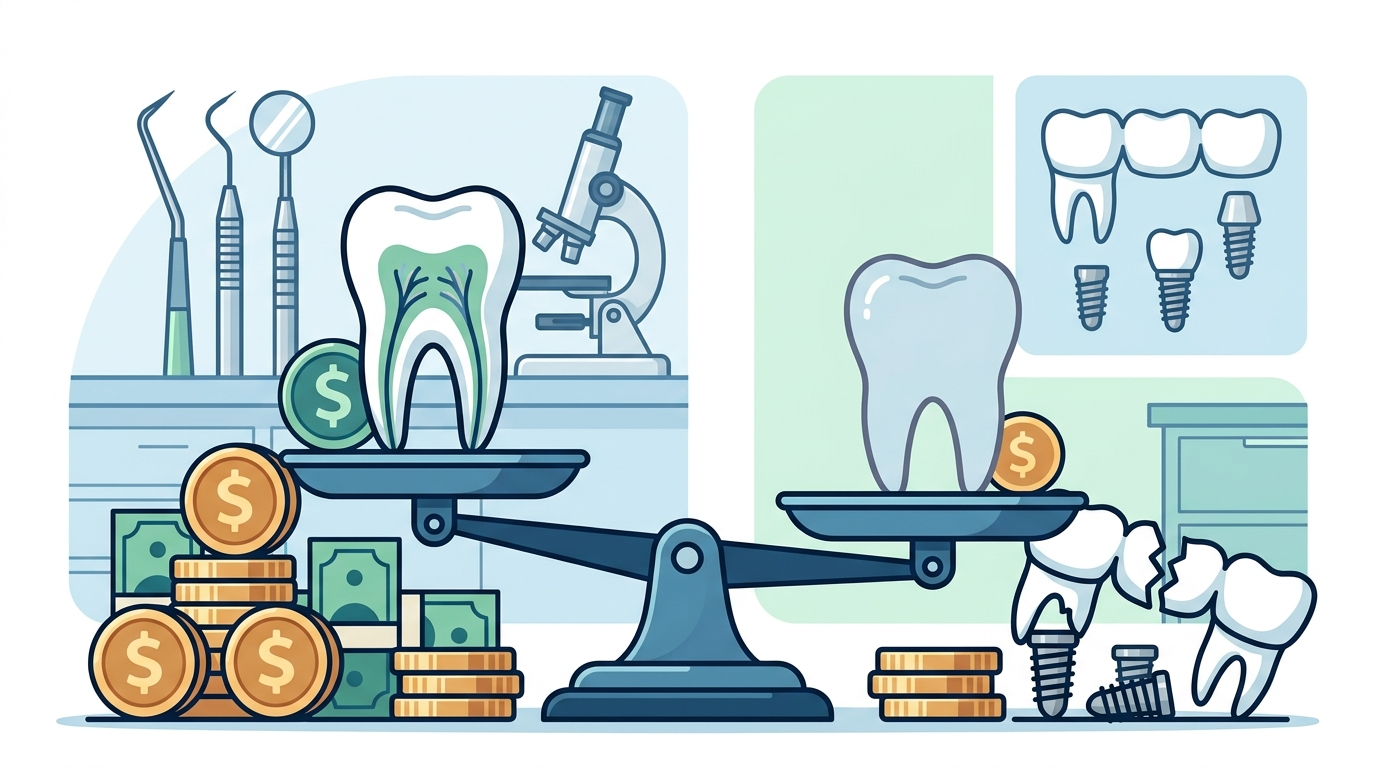
The table below summarizes the key differences between root canal retreatment and tooth extraction, including estimated costs and long-term implications.
| Factor | Root Canal Retreatment | Tooth Extraction |
|---|---|---|
| Initial Cost | $1,000 - $2,500 | $150 - $650 |
| Long-Term Cost (with replacement) | $1,500 - $3,500 (including crown) | $3,500 - $6,500 (implant + extraction) |
| Procedure Time | 1-2 visits | 1 visit |
| Tooth Preservation | Yes | No |
| Bone Loss Risk | Minimal | Significant over time |
| Success Rate | High with specialist care | 100% (tooth removed) |
When to Choose Retreatment vs. Extraction
The decision to retreat or extract depends on several clinical factors. Dr. Adams and his team at Richmond Endodontics evaluate each case individually using PreXion CBCT imaging to assess bone health and root structure.
Choose Retreatment If:
- The tooth has sufficient structure to support a crown.
- The root canal anatomy is accessible and treatable.
- You want to avoid the high cost of implants or bridges.
- You prefer to keep your natural teeth for optimal function.
Choose Extraction If:
- The tooth is fractured vertically below the gum line.
- There is insufficient bone support due to severe periodontal disease.
- The root canal system is too complex or calcified to be successfully treated.
- The patient has medical conditions that contraindicate prolonged dental procedures.
At Richmond Endodontics, we also specialize in treating cracked teeth, which may sometimes be saved with retreatment or other endodontic therapies. Our commitment to advanced technology ensures that we can accurately diagnose whether a tooth is salvageable.
Key Takeaways
- Root canal retreatment costs $1,000 to $2,500, while extraction costs $150 to $650 initially.
- Total long-term costs for extraction plus replacement (implant/bridge) often exceed retreatment costs.
- Retreatment preserves natural tooth structure and prevents bone loss.
- Dr. Benjamin Adams has over 20 years of experience in endodontic retreatment.
- Richmond Endodontics serves Eastern Indiana and Western Ohio with specialized care.
- Advanced technology like the Zeiss ProErgo microscope improves retreatment success rates.
- Insurance coverage may vary, so checking benefits before treatment is crucial.
Frequently Asked Questions
Is root canal retreatment more painful than the first procedure?
Most patients report that retreatment is no more painful than the initial root canal. Modern anesthesia and sedation options ensure comfort throughout the procedure.
How long does root canal retreatment take?
Retreatment typically requires one to two visits, depending on the complexity of the case and the presence of infection.
Can a tooth be retreated multiple times?
While possible, each subsequent retreatment has a lower success rate. Extraction and implant placement may be recommended after multiple failures.
Does insurance cover root canal retreatment?
Many dental insurance plans cover a portion of retreatment costs, similar to the initial root canal. Coverage limits and percentages vary by plan.
What is the success rate of root canal retreatment?
Success rates for retreatment are high, particularly when performed by an endodontist using advanced imaging and microscopic techniques.
Why do root canals fail?
Common causes include missed canals, delayed crown placement, new decay, or cracked teeth that allow bacteria to re-enter the root system.
Is an implant better than a retreated tooth?
A natural tooth is generally preferred over an implant if it can be successfully saved. Natural teeth provide better proprioception and preserve jawbone health.
Schedule Your Consultation
Do not let cost concerns delay necessary care. At Richmond Endodontics, we provide transparent pricing and flexible payment plans to make advanced endodontic care accessible. Dr. Benjamin Adams and our team are dedicated to helping you make the best decision for your oral health.
Contact us today at 765-939-6355 to schedule a consultation. We serve patients in Richmond, IN, and surrounding areas including Centerville, Cambridge City, Connersville, Winchester, Union City, Portland, Dayton, Greenville, Eaton, Troy, Springfield, Urbana, and Celina. Visit our contact page to learn more about our office hours and location.