

When a previous root canal fails, patients often face a critical decision that impacts their long-term oral health. According to recent clinical data, approximately 5% to 10% of root canals may require retreatment due to complex anatomy or new infections. Understanding the differences between non-surgical retreatment and surgical apicoectomy is essential for preserving your natural tooth. At Richmond Endodontics, we utilize advanced technology to determine the most effective path for your specific case. (About Our Office Richmond)
Understanding Why Root Canals Fail
A root canal treatment is designed to save a tooth by removing infected pulp and sealing the canal system. However, teeth are complex structures with intricate networks of microscopic channels. Sometimes, these channels are missed during the initial procedure, or the seal breaks down over time due to decay or trauma. Endodontic failure is defined as the persistence or recurrence of symptoms and signs of apical periodontitis associated with a previously treated tooth. (Home Richmond Endo)
When this occurs, it does not mean the tooth must be extracted. Modern endodontics offers two primary solutions to rescue the tooth. The choice between them depends on the location of the infection, the accessibility of the root canals, and the structural integrity of the tooth. Dr. Benjamin Adams and our team at Richmond Endodontics evaluate each case using high-resolution imaging to ensure we recommend the most conservative and effective option. (Home Richmond Endo)
Root Canal Retreatment: The Non-Surgical Approach
Root canal retreatment is typically the first line of defense when a previous treatment fails. This procedure involves accessing the tooth through the crown, removing the existing filling materials, and cleaning the canals again. The goal is to eliminate any remaining bacteria and reseal the tooth to prevent reinfection.
When Is Retreatment Recommended?
Retreatment is often recommended when there is evidence of persistent infection at the root tip, but the root canals are accessible through the crown. Common scenarios include:
- Missed canals that were not detected during the initial treatment.
- Complex canal anatomy that was difficult to clean initially.
- Delayed or defective crowns or fillings that allowed bacteria to re-enter the tooth.
- Fractured instruments that block the canal path.
This approach preserves the natural structure of the tooth without the need for incisions. It is generally less invasive than surgery and allows for a quicker recovery time. Patients often report minimal discomfort during the healing process, which typically resolves within a few days.
Apicoectomy: The Surgical Alternative
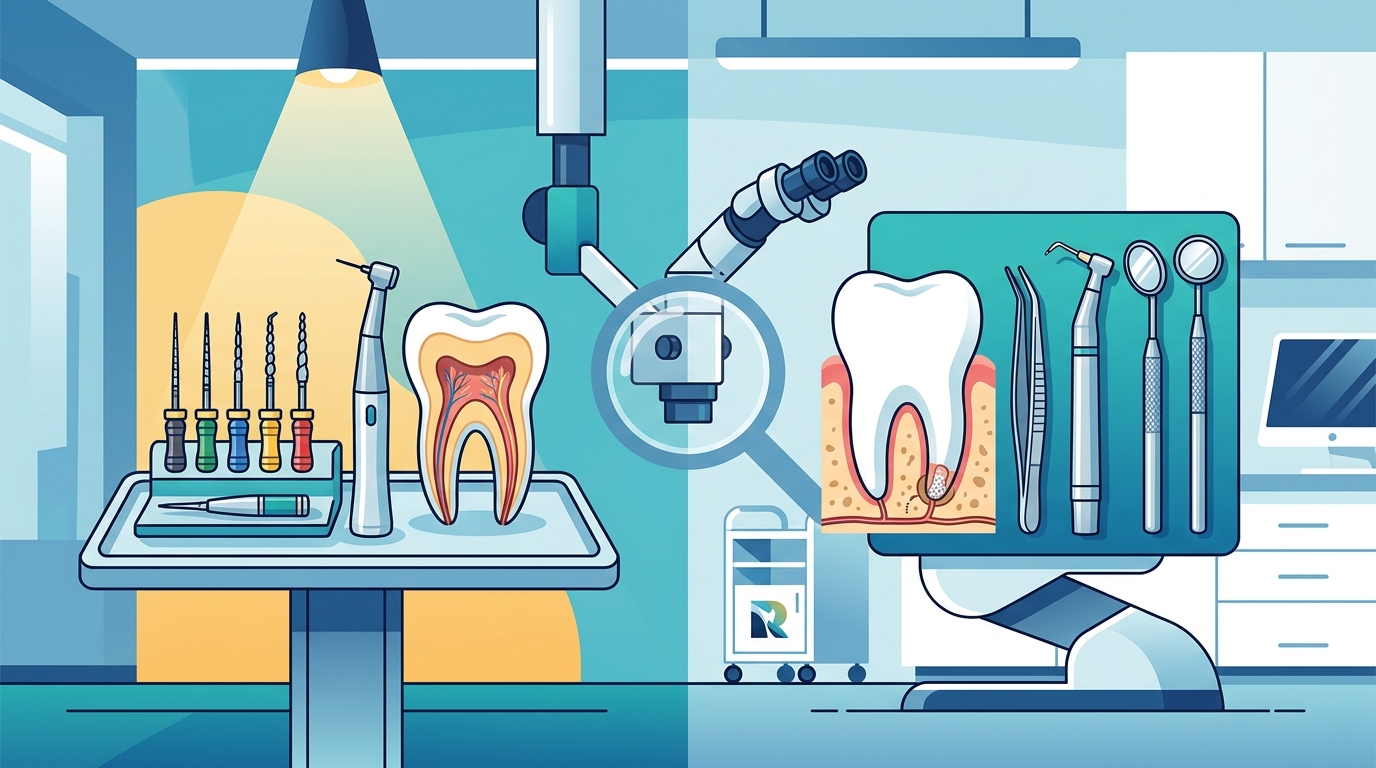
An apicoectomy, also known as root-end surgery, is a microsurgical procedure performed when retreatment is not feasible or has already failed. This procedure involves accessing the root tip through the gum tissue to remove the infected tip and seal the end of the root from the outside.
When Is Apicoectomy Recommended?
Surgery is indicated when non-surgical retreatment is not possible due to anatomical constraints. Dr. Adams frequently performs apicoectomies for cases involving:
- Calcified canals that cannot be negotiated with standard instruments.
- Large posts or crowns that would require excessive removal of tooth structure to access the canals.
- Perforations or blockages in the root canal that cannot be bypassed.
- Roots that are curved or bent, making access from the crown impossible.
During an apicoectomy, the surgeon makes a small incision in the gum to expose the root and surrounding bone. The infected tissue is removed, and the tip of the root is trimmed. A small filling is placed at the tip to seal the root canal. This procedure is highly effective at resolving persistent infections and saving teeth that might otherwise be extracted.
The Role of Advanced Technology
At Richmond Endodontics, we leverage cutting-edge technology to enhance the success rates of both retreatment and apicoectomy procedures. Our commitment to innovation ensures that patients receive the highest standard of care.
Zeiss ProErgo Surgical Microscope
The Zeiss ProErgo surgical microscope provides superior magnification and lighting. This tool is critical for both retreatment and surgery, allowing us to detect the finest details in the root canal system that are often invisible to the naked eye. In retreatment, it helps locate missed canals. In apicoectomy, it ensures precise removal of infected tissue and accurate sealing of the root end.
PreXion CBCT Imaging
Three-dimensional imaging is essential for accurate diagnosis and treatment planning. The PreXion CBCT provides highly detailed 3D images with lower radiation exposure compared to traditional x-rays. This technology allows us to visualize the exact location of the infection, the shape of the roots, and the proximity to vital structures like nerves and sinuses. This clarity is vital for determining whether retreatment or surgery is the better option.
EdgePro® Laser Disinfection
Our EdgePro® laser disinfection technology offers a more efficient and precise way to clean and disinfect the root canal system. This enhances healing and reduces the risk of reinfection, particularly in complex retreatment cases where bacteria may be hidden in lateral canals.
Comparison Summary
Choosing between root canal retreatment and apicoectomy requires a careful evaluation of your specific dental anatomy and the history of your previous treatment. Below is a detailed comparison to help you understand the key differences.
Detailed Procedure Comparison
| Feature | Root Canal Retreatment | Apicoectomy |
|---|---|---|
| Approach | Non-surgical, accessed through the crown | Surgical, accessed through the gum |
| Invasiveness | Low | Moderate |
| Recovery Time | Typically 1-2 days | Typically 3-5 days |
| Best For | Accessible canals, missed anatomy, defective restorations | Calcified canals, posts/crowns, complex root anatomy |
| Technology Used | Microscope, XDR Digital X-Rays, EdgePro® | Zeiss ProErgo Microscope, PreXion CBCT |
| Success Rate | High, depending on accessibility | High, up to 90% in suitable cases |
Key Takeaways
- First-Line Treatment: Root canal retreatment is generally the preferred initial option because it is non-surgical and preserves more tooth structure.
- Surgical Necessity: Apicoectomy is indicated when retreatment is not feasible due to anatomical barriers or previous restorations.
- Dr. Adams' Expertise: Dr. Benjamin Adams has over 20 years of experience in both surgical and non-surgical endodontics, ensuring expert care for complex cases.
- Technology Matters: The use of the Zeiss ProErgo microscope and PreXion CBCT imaging significantly increases the success rate of both procedures.
- Regional Care: Richmond Endodontics serves patients across Eastern Indiana and Western Ohio, including Richmond, Dayton, and surrounding communities.
- Patient-Centered Care: We intentionally see fewer patients per day to dedicate ample time to each individual, ensuring thorough education and comfort.
- Long-Term Health: Saving your natural tooth through retreatment or apicoectomy is crucial for maintaining proper chewing function and preventing bone loss.
Frequently Asked Questions
How do I know if I need retreatment or an apicoectomy?
The decision depends on the specific anatomy of your tooth and the reason for the failure. If the root canals are accessible through the crown, retreatment is usually preferred. If there are obstructions like posts or calcified canals, an apicoectomy may be necessary. Dr. Adams will use CBCT imaging to make this determination.
Is an apicoectomy painful?
Most patients report that an apicoectomy is no more uncomfortable than having a root canal initially. Local anesthesia is used to numb the area, and post-operative discomfort is typically managed with over-the-counter pain medication. Recovery is generally quick, with most patients returning to normal activities within a few days.
What is the success rate of root canal retreatment?
Root canal retreatment has a high success rate, particularly when performed with advanced microscopy. The success depends on the ability to clean and seal the canals effectively. Our use of EdgePro® laser disinfection further enhances outcomes by eliminating residual bacteria.
Can I still get a crown after an apicoectomy?
Yes, in most cases, you can receive a crown after an apicoectomy. The procedure focuses on the root tip and does not typically compromise the crown of the tooth. However, if the existing crown is defective, it may need to be replaced to ensure a proper seal.
How long does the healing process take?
Healing from an apicoectomy usually takes a few weeks for the bone to fully regenerate. Initial discomfort subsides within a few days. Retreatment recovery is often faster, with most patients feeling normal within 24 to 48 hours.
Why choose Richmond Endodontics for these procedures?
We are one of the few practices in the country offering GentleWave® and EdgePro® laser disinfection, along with the Zeiss ProErgo surgical microscope. Our focus on precision, compassion, and patient well-being sets us apart. We see fewer patients each day to ensure you receive personalized attention.
Schedule Your Consultation
If you are experiencing pain or have been diagnosed with a failed root canal, do not wait. Early intervention is key to saving your tooth. Contact Richmond Endodontics to schedule a consultation with Dr. Benjamin Adams. We are dedicated to providing you with the highest standard of endodontic care in a comfortable and compassionate environment.
Click here to book your appointment online or call us at (765) 939-6355. We proudly serve patients from Richmond, Centerville, Cambridge City, Connersville, Winchester, Union City, Portland, Dayton, Greenville, Eaton, Troy, Springfield, Urbana, Celina, and nearby communities.